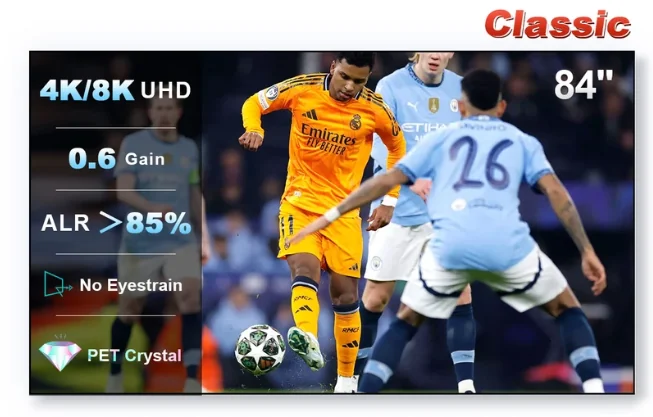
Alternative shopping works best when you define why you might not choose the PET Crystal Classic. If your constraint is wall permanence, light rejection, seating width, speaker placement or installation, the best alternative category changes.
1. A higher-rejection UST screen
If your room is unusually bright, compare screens positioned with stronger ambient-light rejection. Do not treat a larger percentage as an automatic winner: viewing cone, gain and the direction of ambient light all matter.
2. A Fresnel UST screen
Fresnel screens use a different optical structure and can offer strong control of light from unwanted directions. They can also have a more directional viewing behavior, so seating width matters.
3. A motorized floor-rising UST screen
This format is useful when you want a large image without a permanent wall-mounted frame. You trade simplicity for moving parts, higher cost and more installation considerations.
4. A drop-down UST screen
Ceiling or wall-mounted retractable designs preserve the wall when not in use. Tensioning and exact UST compatibility deserve careful attention because small surface deviations are more visible with steep projection angles.
5. Better room light control
Sometimes the best alternative is not a different screen. Curtains, blinds and better fixture placement can reduce the amount of unwanted light reaching the image surface.
Still considering the PET Crystal Classic?
Check the live offer after comparing the format and technology trade-offs above.
Check Current OfferAffiliate link: we may earn a commission if you buy through this link, at no extra cost to you.
Keep researching
PET crystal vs Fresnel
Compare optical screen approaches.
Fixed frame vs floor rising
Compare permanent and retractable formats.
Bright-room screens
Match the screen to ambient-light conditions.