Core concepts
How ALR screens work
Directional reflection, absorption and why the projector angle matters.
ALR vs CLR
How the terminology overlaps and what to evaluate beyond the acronym.
PET crystal vs Fresnel
Compare common UST optical structures without assuming one is universally superior.
Projector screen gain
Why lower or higher gain changes brightness distribution and viewing behavior.
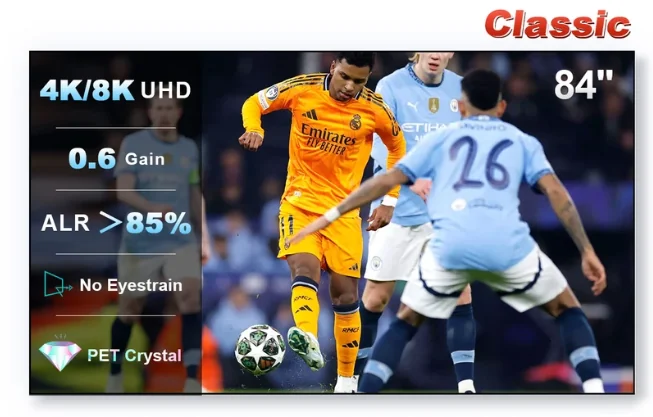
Specs need context
Ambient-light rejection percentages, gain numbers and viewing-angle claims can be useful, but they are not a substitute for matching the screen to projector geometry and the room. A UST screen is designed to accept light arriving from a very steep angle and reduce competing light from other directions.