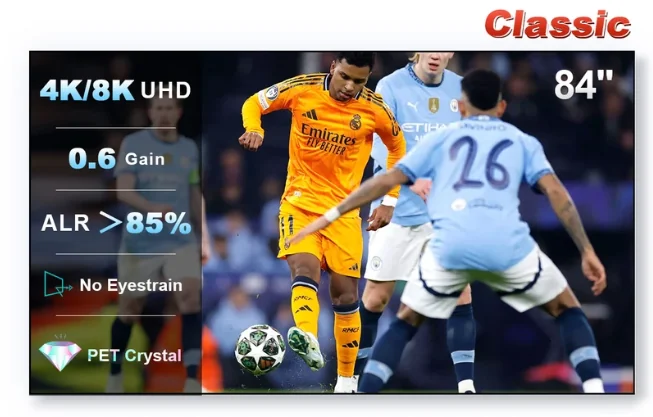
ALR means ambient light rejecting. CLR is commonly used to mean ceiling light rejecting. In UST marketing, the terms can overlap because many UST screen structures are designed to reduce light arriving from above while accepting light from the projector below.
Why the label is not enough
Two screens can both carry ALR or CLR language and still behave differently. Ask about projector compatibility, gain, viewing cone, surface structure and which directions of ambient light the screen is designed to manage.
For UST, geometry comes first
Do not buy a long-throw ALR surface simply because it says “ambient light rejecting.” UST requires a screen designed for steep-angle projection from close to the wall.
Use the room as the test
Map windows, ceiling fixtures and seating positions. If the strongest unwanted light comes from above, ceiling-light rejection is relevant. If light is entering from a large side window, the screen's broader directional behavior becomes more important.
See the NothingProjector PET Crystal Classic offer
Check current price, size availability and merchant terms before ordering.
Check Current OfferAffiliate link: we may earn a commission if you buy through this link, at no extra cost to you.
Keep researching
How ALR works
Understand directional light control.
Bright-room screen guide
Apply the concepts to a real room.
PET crystal vs Fresnel
Compare two UST screen structures.