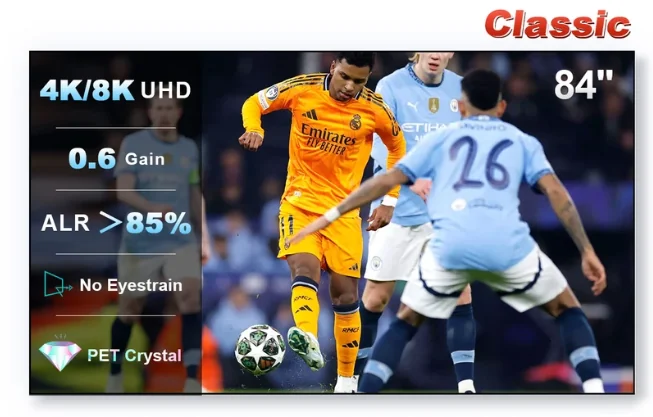
PET crystal/lenticular-style UST screens use fine optical structures intended to accept the steep light from a projector below the screen while reducing unwanted light from other directions. Fresnel screens use a different directional optical structure that can deliver strong ambient-light control but may behave more narrowly off-axis.
PET crystal strengths
- Often designed around broad living-room seating
- Common in fixed-frame and retractable UST products
- Can balance ambient-light rejection with a relatively wide viewing angle
Fresnel strengths
- Strong directional control can be attractive in difficult light
- Can preserve contrast when much of the unwanted light arrives outside the accepted viewing geometry
The trade-off
Directional control is useful because it rejects light, but greater directionality can also make seating position more important. Compare your sofa width, room lighting and projector output rather than treating the screen surface as an isolated spec.
Where the PET Crystal Classic sits
NothingProjector currently states 0.6 gain, 160° viewing angle and 85% ambient-light rejection for the fixed-frame PET Crystal Classic. Those published figures position it as a broad-viewing UST screen rather than simply chasing the highest rejection percentage.
See the NothingProjector PET Crystal Classic offer
Check current price, size availability and merchant terms before ordering.
Check Current OfferAffiliate link: we may earn a commission if you buy through this link, at no extra cost to you.
Keep researching
Projector screen gain
Understand what 0.6 gain means.
Classic vs Black Series
Compare the merchant's UST screen lines.
UST ALR buying guide
Turn technology into a buying decision.